
SEO is changing, and the “predictable” era of clicks is over. In a recent podcast episode on The Unscripted SEO, Jesse Ringer and Jeremy Rivera explored why marketers need to stop chasing rankings and start building owned assets.
For a long time, SEO operated on a simple value exchange.
Brands invested in useful content. Google surfaced it, driving traffic back to the brand’s website.
That model was never perfect, but it was predictable enough to justify the investment. If a page ranked well, it could drive visibility, visits, and business outcomes.
That’s what’s changing now.
As search results evolve with more zero-click experiences, on-SERP answers, and AI-generated summaries, the path from content creation to site traffic is becoming less dependable. This doesn’t mean SEO matters less. It means the way it creates value is evolving.
For marketers, that creates a more difficult question: how do you defend SEO when visibility no longer guarantees a visit? If traffic is less predictable, rankings are less meaningful, and visibility doesn’t always translate into visits, then SEO value can’t be evaluated the same way it was a few years ago.
The channel still matters. But the old exchange is getting weaker, and the expectations around SEO need to evolve with it.
The biggest shift in SEO isn’t AI—it’s accountability
AI may be dominating the conversation, but the more important shift is what it is forcing marketers to confront.
For years, SEO was often measured through familiar proxies. Rankings were easy to report on. Traffic growth was still meaningful—but in many cases, those metrics were treated as enough to signal progress, even when the connection to revenue was less clear. In many cases, those metrics were enough to signal progress, even when the connection to revenue was less clear.
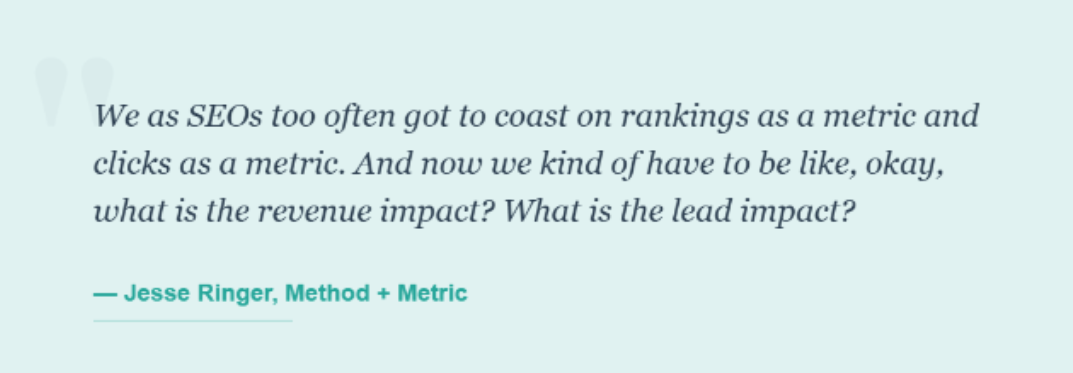
That reliance on rankings and traffic as standalone proof points is getting harder to justify. Rankings still matter less than they used to, and while traffic remains meaningful, neither metric is enough on its own. A page can rank well and still do very little for the business.
The conversation is moving from “Did this page perform?” to “What did this actually help create?”
For marketers, that means SEO needs to be evaluated with more commercial context. Qualified leads, pipeline influence, revenue impact, and audience growth matter more than visibility in isolation. The era of using rankings and traffic as standalone proof points is fading. What matters now is whether SEO can demonstrate contribution, not just presence.
AI is making content easier to produce and harder to differentiate
AI has made content production faster, cheaper, and easier to scale. The question is what happens when that efficiency becomes available to everyone?
The issue is not that AI can create content, it’s that it makes it easier for brands to publish generic content at scale. When more teams can produce more content with less effort, the advantage no longer comes from volume. It comes from what feels unique.
That is where many content strategies are going to struggle.
As Jesse put it, “If you take that away by putting in mediocre content that sounds like everyone else just for the sake of a couple of clicks, it’s not going to help you in the long run.”
Lower production costs can increase output, but they do not automatically create more trust, stronger positioning, or better business outcomes. More output does not automatically create more trust, stronger positioning, or better business outcomes.
When content starts to sound interchangeable, the brands that stand out are the ones with a clearer point of view and more expertise.
AI can support that work, but it cannot replace the thinking behind it. The brands that win in this environment will not be the ones publishing the most. They will be the ones publishing content that is difficult to replicate.
If Google owns the click, marketers need to own the audience
If search traffic is becoming less predictable, then the value of owned channels goes up.
Search still matters. It remains one of the best ways to create discovery and surface expertise where demand already exists. But if more of that interaction is happening on Google, marketers need to think more carefully about what happens next.
That is where direct relationships become more important.
If Google increasingly controls your clicks, marketers need stronger ways to convert traffic into something they can actually retain. That could mean email and newsletter subscribers, repeat visitors, or any other form of direct audience access that does not depend on earning the same click over and over again.
This is one reason newsletters are becoming more strategically important. They help turn a one-time visit into a long lasting relationship.
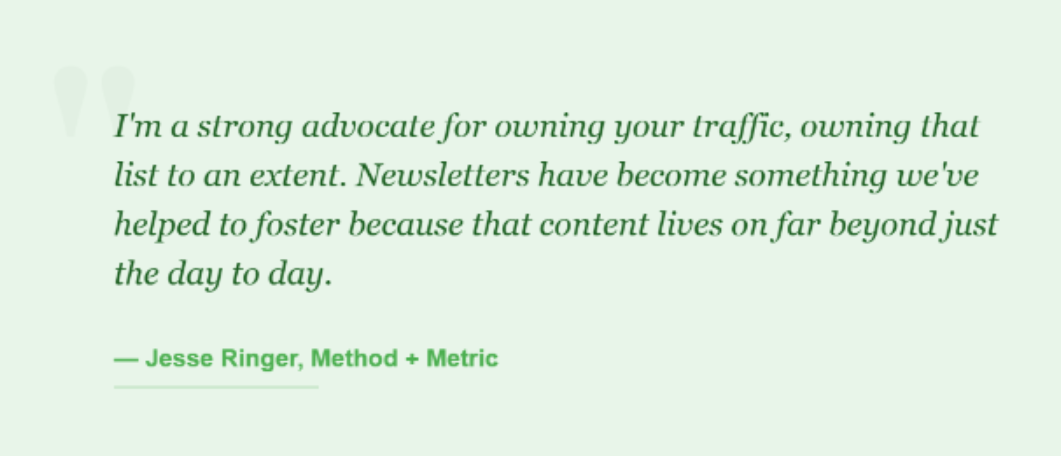
As Jesse also noted, “Newsletters have become something that we’ve also helped to foster because that content lives on far beyond just, you know, just the day to day.”
The goal is no longer just to generate visits. It is to turn visibility into an asset that can compound over time. That means stronger newsletter calls to action, better content-to-email pathways, and more content designed to create return visits, not just one-time discovery.
In a lower-certainty search environment, owned audience is no longer a nice-to-have. It is part of a strong SEO strategy.
Brand is becoming part of SEO performance
For a long time, SEO was treated as a channel built mostly on keywords, rankings, and technical execution.
Those things still matter, but they no longer tell the full story.
As search becomes more fragmented and AI-generated answers become more common, visibility is shaped by more than just whether a page is optimized. It is also shaped by whether a brand is recognized, trusted, and consistently associated with the topics it wants to own.
As Jesse put it, “SEO for a long time was just kind of keywords… And now it’s like, it’s all of it. It’s the brand entity. It’s that brand experience.”
That shift matters because search behavior is no longer confined to one platform or one moment. People discover brands across more platforms, compare options faster, and often validate what they see before they ever click through.
In that environment, brand familiarity becomes part of how SEO performs.
It influences trust. It influences click behavior. It influences how memorable a business feels in a crowded market. In a landscape where more content starts to sound the same, that familiarity becomes a stronger differentiator.
This is also why brand and expertise are becoming harder to separate. The brands that perform best are the ones that make their perspective and credibility easier to recognize.
SEO still depends on strong fundamentals. But in a lower-certainty search environment, brand is no longer adjacent to SEO strategy. It is part of the outcome.
What marketers should prioritize now
If SEO is becoming less click-dependent and more accountable to business outcomes, the strongest strategies will need to evolve with it. That means focusing less on volume and more on what creates durable value.
- Measure SEO beyond traffic: track qualified leads, pipeline influence, revenue contribution, and audience growth.
- Prioritize content that is harder to replicate: original perspective, firsthand experience, and strong specificity matter more than publishing at scale.
- Turn discovery into retention: stronger newsletter CTAs, subscription pathways, and return-visit mechanisms into top-performing content.
- Invest in branded demand: brand familiarity and trust play a bigger role in click behavior and conversion as search becomes more fragmented.
- Treat owned audience as part of SEO strategy: first-party relationships are becoming more valuable as search platforms capture more of the interaction.
SEO still matters, but the teams that will get the most from it are not the ones chasing clicks at any cost. They are the ones using search to build assets that last beyond the visit: trust, audience, and measurable business impact.
In the “After the Click” era, the only thing you truly own is your relationship with your audience. Don’t leave your growth at the mercy of a search algorithm.